Move. Make a guess. Return to the mathematics.動かす。予想する。 数学で確かめる。
How much can a view tell us? Three games to explore mathematical intuition through graphs, complex directions and moving slices.「見えた形」から、どこまでわかるだろう。 グラフ、複素方向、動く切り口を手がかりに、数学的な直観を育てる3つのゲーム。
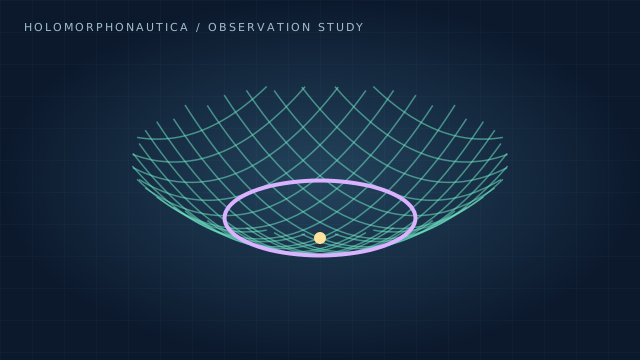
Lift a circle onto a function graph and compare it with the center. Predict subharmonicity, then explore the mathematical explanation.函数のグラフに円周を持ち上げ、中心との関係を観察。劣調和性を予想して、解答の理由と見比べます。
How does a graph’s apparent shape relate to subharmonicity?「くぼんで見える」と劣調和であることは、どうつながる?
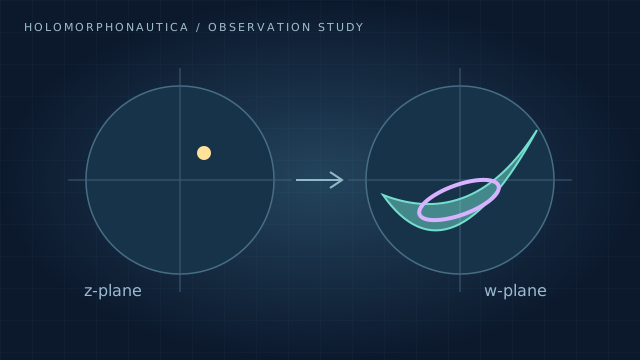
Switch the roles of two complex planes to inspect coordinate slices. Explore oblique complex discs to investigate plurisubharmonicity.二つの複素平面の役割を切り替えて、切片のグラフを観察。斜めの複素円板も使い、多重劣調和性を探ります。
Do coordinate slices tell the whole story?座標ごとの切片だけで、全体の性質は見抜ける?
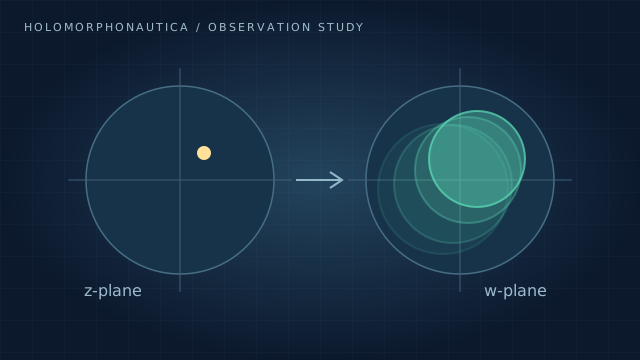
Move a point in one complex plane and follow the domain’s slice in the other. A pseudoconvexity game inspired by Kiyoshi Oka’s ryokuinzu.一方の複素平面で点を動かし、もう一方に現れる領域の切り口を追う。岡潔の「緑陰図」に着想を得た擬凸性のゲームです。
How can moving slices help us picture a four-dimensional domain?変わり続ける切り口から、四次元の領域をどう捉える?
Start at Novice level. Rotate a graph or move a point in a plane, and use the hints freely.初級から始めて、グラフを回したり、平面の点を動かしたり。ヒントも自由に使えます。
Make a prediction予想を選ぶ
Choose Yes or No to reveal the function or domain and the reasoning behind the answer.Yes / No を選ぶと、隠されていた函数・領域と判定の理由が現れます。
Look again with the explanation理由を手がかりに、もう一度
Continue exploring after answering. Answered problems remain available in the gallery for another look.解答後も操作を続けられます。一度回答した問題は、ギャラリーから何度でも観察できます。
Use a mouse or touch. Arrow keys also move points in the parameter planes. Progress is saved in this browser; each game’s Save data screen offers an export.PCではドラッグ、スマートフォンではタッチで操作できます。平面の点はキーボードの矢印キーでも動かせます。進捗はこのブラウザに保存され、各ゲームの「セーブデータ」から書き出せます。
Graphs and hints show a finite view at finite resolution. Compare your visual impression with the mathematical explanation supplied after each answer.描画やヒントは、有限の範囲・解像度で観察するためのものです。見た目だけで判断を終えず、解答に示す数学的な理由と照らし合わせてください。
FROM THE VR PROJECT
Approaching VR observation through the browser.VRで「見る」ことへ、 ブラウザから近づく。
Project Holomorphonautica explores several complex variables and complex analytic geometry in 3D VR. We created these games as practice for observing mathematical objects in 3D VR. You can also enjoy them on their own in your browser: move graphs and slices, make predictions and compare them with the mathematics.Project Holomorphonauticaでは、多変数函数論・複素解析幾何の対象を3D VRで眺め、その直観を育てる試みを進めています。3D VRで数学的対象を見るために、見る側が観察の仕方を練習できるゲームを作りました。グラフや切り口を動かし、予想を数学的な理由と照らし合わせながら、ブラウザだけでも楽しめます。
Which direction should we look from? What should stay fixed? What does a slice allow us to conclude? Bring these questions back to the VR visualizations.どの方向から見るか、何を固定して動かすか、見えている部分から何を言えるか。ゲームで生まれた問いを、VRでの観察にも持ち込んでみてください。
Kyoka Marui, Masakazu Takakura, Ryo Uchimoto and Takayuki Koike discussed what to observe in 3D VR, how to observe it and what we hoped to understand, with the aim of developing intuition in complex analytic geometry. These discussions led to the idea of games as an enjoyable way to practise connecting what we see with mathematical understanding. The four of us jointly developed these three games from this shared concept. We asked Chapio-kun (ChatGPT) to write the code.丸井 京香・髙倉 真和・内本 諒・小池 貴之の4名で、複素解析幾何の直観形成に向けて、3D VRで何をどう観察し、どのような理解を目指すかを議論しました。その議論から、見えたものを数学的な理解につなげるための「見る側の練習」を、ゲームで楽しく行うという発想が生まれました。この構想をもとに、4名で3つのブラウザゲームを共同開発しました。コーディングは、ちゃぴおくん(ChatGPT)に依頼しました。